


Every pet parent faces a challenge when it comes to choosing the right treatment for protecting their pet against pesky parasites. And, the confusion between monthly vs. 3-monthly protection is real. At first glance, it’s easier to note that one is given every month, while the other is given every three months. Both options can provide effective parasite protection when used as directed. In this blog, we will cover the actual difference between monthly vs. 3-month parasite protection in detail so you can make an informed decision.
Let’s dive deeper!
What is monthly parasite protection?
Monthly parasite protection involves treatments that are administered once a month (generally, every 30 days). Depending on the product, monthly treatments protect your pet against fleas, ticks, intestinal worms, heartworms, and other common parasites. Monthly parasite products are available in various forms, such as chewables, tablets, spot-on treatments, or injectables. Monthly treatment can provide year-round protection when given continuously every month.
Popular monthly parasite treatments for pets include:
- NexGard Spectra
- Revolution Plus
- Frontline Plus
- Simparica TRIO
What is 3-month parasite protection?
3-monthly parasite protection includes treatments that are administered once every 3 months (every 12 weeks). It gives long-lasting protection against common parasites such as fleas, ticks, and intestinal worms. 3-month parasite treatments come in chewables and spot-on forms.
The convenience of 3-month parasite treatment is the best part. Pet parents only need to give the treatment four times a year, instead of remembering to administer parasite treatment every month.
Some effective 3-monthly parasite treatments include:
- Bravecto Chews
- Bravecto Topical
What’s the Difference between Monthly and 3-Month Parasite Protection?
- Parasite coverage
Some monthly parasite products are designed to protect your pet against multiple parasites, though coverage varies by product. Depending on the product, a single monthly dose can cover fleas, ticks, intestinal worms, heartworms, or other parasites, making monthly parasite treatment a convenient all-in-one solution for pets.
On the other hand, three monthly parasite products are generally focused on fleas and ticks. Specific parasite coverage depends on the product and your pet’s needs, but pets may still require additional treatment for worm control or prevention of heartworm disease.
Remember that parasite coverage of both options may differ between products and parasite species you are targeting. Always check the product label for specific parasite coverage.
- Convenience
Convenience and ease of use can be a major deciding factor, especially for busy pet parents.
Monthly parasite treatments require 12 administrations throughout the year. Pet parents can put on a reminder for scheduled dosing, but there’s still a possibility of forgetting a dose. While three-monthly parasite treatments require 4 administrations per year, this can be easier to manage for some pet parents.
- Cost
Monthly treatments have a quite lower upfront cost as they are purchased more frequently. In comparison, 3-month treatments are expensive per dose, but they provide long-lasting protection. The additional costs may apply if separate worming or heartworm prevention products are used alongside the 3-monthly flea and tick preventatives.
Pet parents are mostly focused on the price of a single dose while purchasing parasite treatment. But it’s more helpful when you compare the annual cost of providing parasite protection throughout the year.
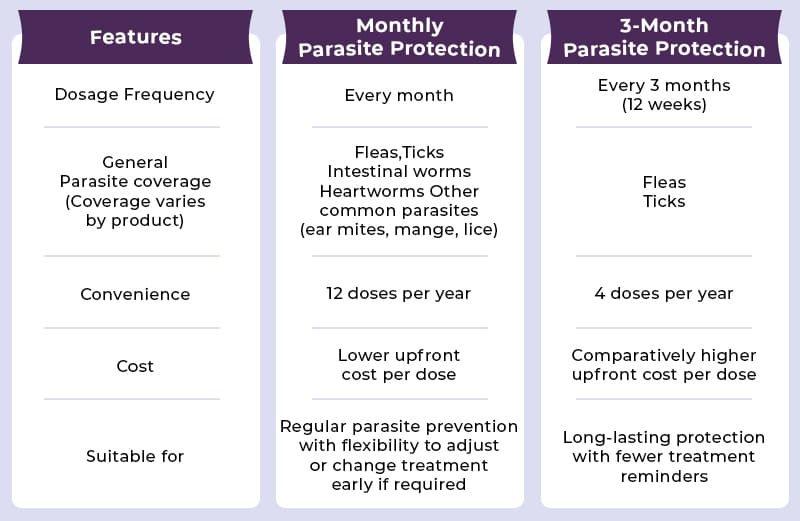
Comparison Table: Monthly vs. 3 Month Parasite Protection
Final Thoughts
Both monthly and 3-month parasite protection options for pets have their own unique benefits and drawbacks. When used as per instructions, both options can provide effective parasite protection to your pet. Choose the preventive based on your pet’s needs and your ability to maintain the treatment schedule. Be consistent and provide your pet with the best care.
Frequently Asked Questions
1. Which parasite protection helps reduce missed doses?
Usually, pet parents choose long-lasting parasite preventatives that are administered once every 3 months. The reduced number of doses helps pet parents remember the doses.
2. Does longer mean better protection?
No. Longer duration means how long the treatment will remain active in your pet’s body. It does not automatically mean a better formula, higher efficacy, or protection against future infestations.
3. Can I switch between monthly and 3-month parasite protection options?
Yes, you can switch between monthly and 3-month parasite treatments, but you need to plan the change carefully, as there’s a risk of overlapping treatments or a protection gap. For better guidance, it’s always best to talk to your veterinarian, who may offer you a customized solution based on your pet’s needs.
4. What happens if I miss a dose?
Missing or forgetting a dose can open a window for parasites to attack your pet. In such condition, talk to your veterinarian for further guidance.